

How to choose a sound post-production studio in Warsaw
You’ll recognize a good sound post-production studio not by its price list, but by how its previous work sounds and how efficiently it joins your project. Warsaw has many places offering “sound for film” — below are specific criteria that will help you choose well and not overpay for a lack of results.
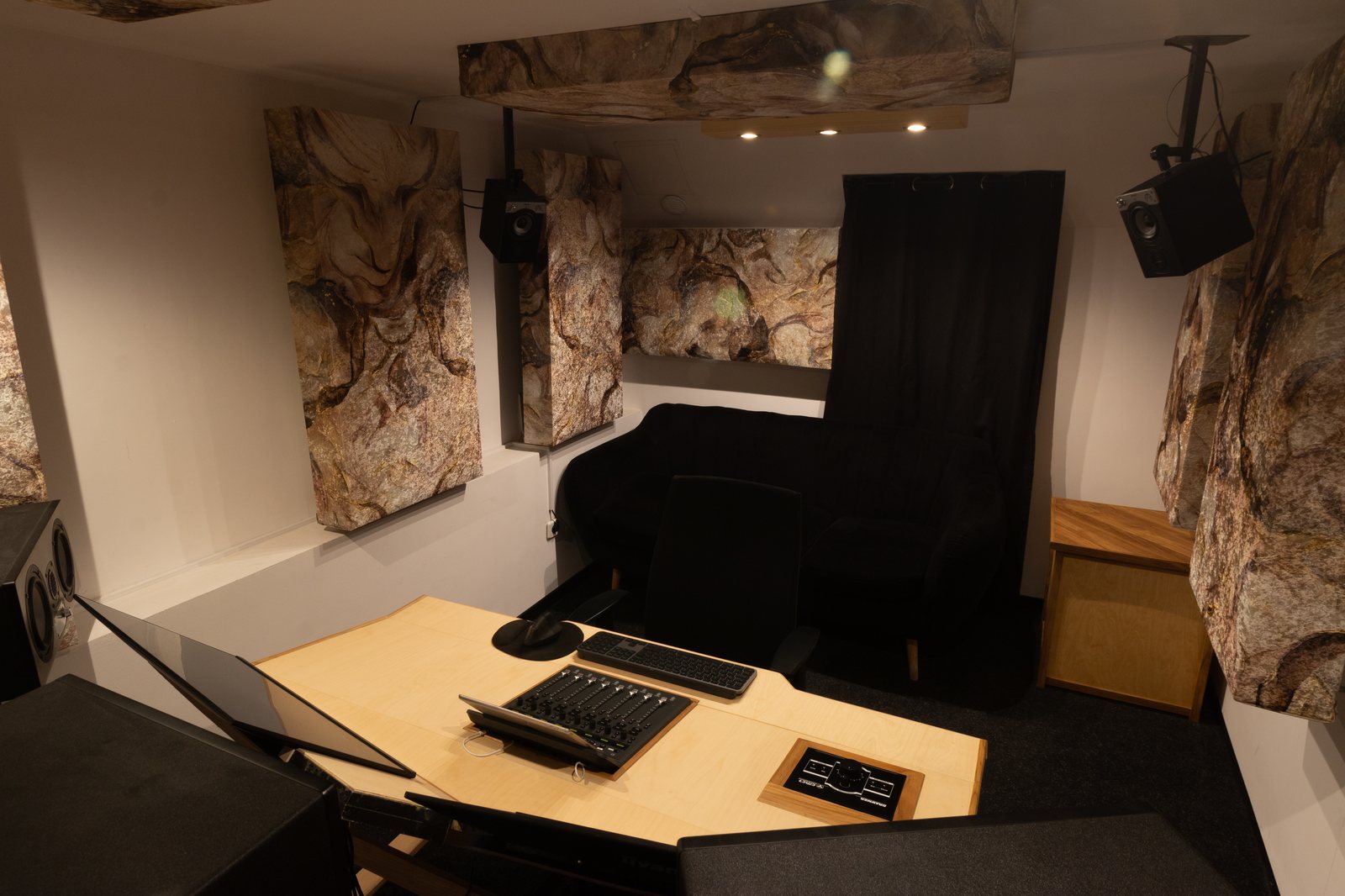
1. Acoustics and monitoring
This is the foundation. A studio may have the most expensive equipment in the world, but if the room is poorly soundproofed, the editor hears a distorted picture of the sound and makes wrong decisions.
Pay attention to:
- the monitoring configuration — for a film, series or advertisement for VOD platforms you need 5.1 or surround monitoring; for a podcast, good stereo is enough,
- the monitors — full-range, trustworthy speakers (in our case Eve Audio + Genelec) let you hear what is really in the material,
- a standardized monitoring level — thanks to which the mix sounds consistent across different devices.
2. Equipment and software
The industry standard is Pro Tools — if a studio works in a different environment, exchanging projects with the rest of the film crew can be harder. It is worth asking about:
- the version and configuration of the DAW (in our case Pro Tools Ultimate with 5.1 monitoring),
- the control surface (Avid S1) and the recording microphones (Neumann TLM 102),
- the sound library — ours is 4 TB and shortens the time it takes to build effects.
We describe the full list of equipment and our approach to work in the about us section.
3. Experience and team
Equipment doesn’t make the sound — people do. Ask who will actually work on your project and what experience they have. At All In Sound, projects are run by a specialized two-person team: Olga is responsible for dialogue editing, ADR and sound editing, Yohan Boisgontier for the mix and music. This way you know who has a hand on your material — it does not disappear into an anonymous queue.
4. References and portfolio
The best proof of quality is previous work. Ask for a portfolio and case studies , and listen to how it sounds. A good signal is work on productions for recognizable broadcasters — we have delivered sound for material broadcast by, among others, Netflix, Prime Video, BBC and France TV. That means we work to the technical standards required by large platforms.
5. Workflow and flexibility
A good studio can join a project at your stage and in your format — it will accept an AAF/OMF export, cope with material from various editing programs and advise on how to prepare the files. Ask:
- whether they work remotely and how they exchange versions,
- how many rounds of revisions are standard,
- in which formats and loudness standards they deliver the master.
6. Location — does it matter?
The editing and mix themselves can be run remotely, but for voice-over recordings, re-recordings and joint monitoring, being close to the studio can be convenient. Our studio is located in Warsaw’s Żoliborz district, at ul. Śmiała 42 — close to the centre, with convenient access for live sessions.
7. Questions worth asking before working together
Before you decide, a short conversation will clear up most doubts. It is worth asking:
- Who specifically will work on the project and what experience do they have in your genre?
- In which formats do you deliver the master and do you support platform loudness standards (e.g. EBU R128)?
- How many rounds of revisions are in the standard quote?
- What does communication look like — will I get versions to review online, and how quickly?
- Will you help prepare the export from my editing program?
A reliable studio will answer these questions concretely and without evasion. Evasive answers are a warning sign — sound is a collaboration, not a black box.
What to avoid
- studios that don’t want to show previous work,
- a lack of clear information about the team and equipment,
- a “blind” quote without viewing the material — a reliable studio will get to know the project first.
How much does sound post-production cost?
Prices in Warsaw vary depending on the scope, the length of the material and the complexity. Treat any ranges as a guide — a fair quote can only be given after getting to know the project. We always start by viewing the material and preparing an estimate with a schedule.
Summary
When choosing a sound post-production studio in Warsaw, look at the acoustics and monitoring, the equipment, the team’s experience, references and the way they work — not solely at the price. These elements determine whether the final sound will sound professional on every screen and on every platform.
Looking for a studio for your project? Write to us or call +48 602 736 922 — we’ll be glad to show you our work and discuss your material.
Frequently asked questions
What to look for when choosing a sound studio?
The acoustics and monitoring configuration (e.g. 5.1), the equipment and software, the team’s experience, references, and the way they work — whether the studio can join your project at your stage and in your format.
Does a studio have to have 5.1 monitoring?
If you are making a film, series or advertisement for large screens and VOD platforms — yes, because the final mix there is sometimes surround. For a podcast or a simple spot, well-prepared stereo monitoring is entirely sufficient.
Is it worth choosing a studio close to you?
Location helps with live sessions — voice-over recordings, re-recordings, joint monitoring. The editing and mix themselves can be run remotely, exchanging files and versions online.
How can I check a studio's quality before working together?
Ask for a portfolio and case studies, listen to previous work, ask about the equipment and the team. Good signals are client references and work on productions for well-known broadcasters.