

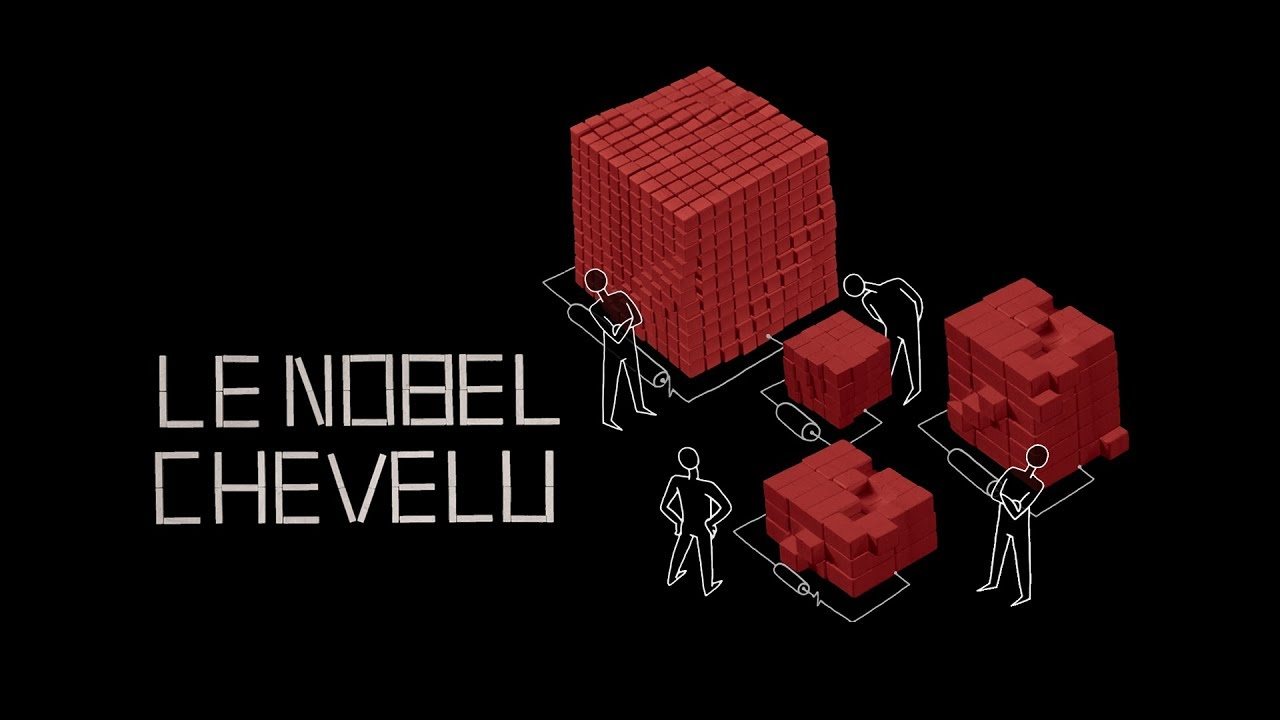
Le Nobel Chevelu — sound design for animation
Awards and recognition: Le Nobel Chevelu — a stop-motion animated short film about quantum physics (topology), made in collaboration with physicists (ENS Lyon / CNRS / Université Paris-Saclay) — won the Audience Award for Best Short Film at the Rencontres Internationales Sciences et Cinémas festival (2021). On this award-winning animation, Olga Pasternak — a sound engineer and co-founder of All In Sound — was the sound mixer (re-recording mix) (IMDb ).
Le Nobel Chevelu is an animated film, and animation arrives at the studio as a silent image — the entire sonic layer is created in post-production. On this film, Olga Pasternak handled the sound mix (re-recording mix); today she co-runs All In Sound. The mix is the stage at which the separate layers — sound track, Foley, dialogue and music — are balanced into one coherent track and precisely matched to the image. Olga brings the experience of such projects to the studio’s work.
The role of sound in animation
Animation gives the sound artist something found nowhere else: full freedom and full responsibility. The drawn world has no natural sound, so its character is defined by sound. It is a creative decision whether a character moves lightly and comically or heavily and menacingly — and this is often determined not by the animation but by the choice and rhythm of the effects.
The key layers are sound design and Foley. Sound design creates the world and its rules: the sound of objects, phenomena, gags. Foley adds physicality — footsteps, rustle, touch — so that the drawn character gains weight and presence. In animation, especially comedy, timing also plays a huge role: an effect a few frames late ruins the joke, while a perfectly placed one can make you laugh by its precision alone. To this are added the character’s voice and the music, which lead the narration and the emotions.
The craft of the mix
The mix is the moment when many separate layers become a single track. The mixer arranges the planes — deciding what sits up close and what stays in the background — builds space and depth, pans sounds across the stereo field, and watches over dynamics and clarity. In animation there is the added demand of absolute synchronisation: the effect has to hit the frame in which something happens on screen, because here there is no margin for error. A well-made mix is invisible — the viewer never notices it, and yet it is what decides whether the drawn world feels real and tangible.
Experience at All In Sound
Projects like Le Nobel Chevelu are the kind of experience Olga brings to All In Sound. At the studio we handle the full sound of animation — from sound design based on a 4 TB library, through live Foley recording, to the mix that binds it all together. We write more about how we work with Foley in a separate article on the blog .
See our other projects or write to us — if you are making an animation, we would be glad to take care of its sound.
Frequently asked questions
Why does animation require building sound from scratch?
Animation has no production sound — the image is created entirely by drawing or by computer. Every step, touch, gust and effect has to be created and synchronised by hand. The entire soundtrack is therefore a work of post-production from the first to the last second.
What is Foley in animation?
Foley is the sounds of movement and contact recorded live in the studio — footsteps, the rustle of clothing, the touch of objects. In animation, Foley gives characters weight and physicality, so that the drawn world begins to feel real and tangible.