

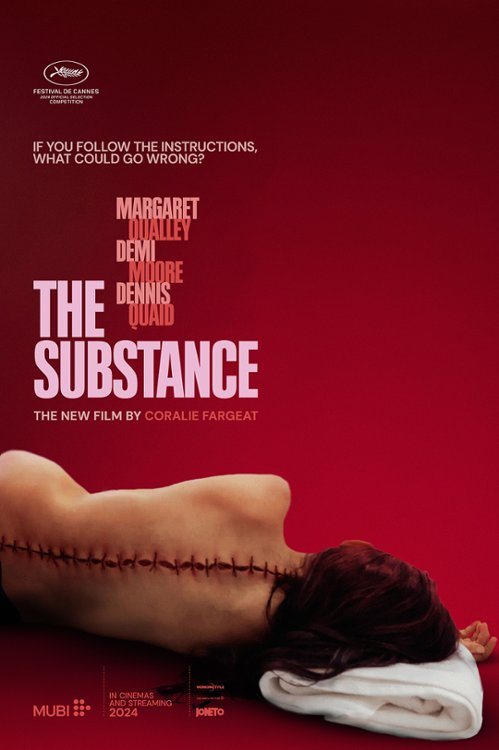
The Substance — sound post-production
The Substance is the acclaimed body horror directed by Coralie Fargeat, starring Demi Moore and Margaret Qualley. The film is obsessively concerned with the body, youth and decay — and it is a genre in which sound is not a background but the main tool for affecting the viewer. Where the image suggests, the sound spells out; where the camera turns away, the ear stays at the scene of the event.
Awards and recognition: The Substance is one of the most awarded titles of its year — it won the Academy Award (Oscar) for Best Makeup and Hairstyling (2025 ceremony) out of a total of 5 Oscar nominations, the award for Best Screenplay at the Cannes Film Festival (2024), and Demi Moore received the Golden Globe for Best Actress. On a body horror this acclaimed, the sound layer — sound design, Foley and mix — was one of the key tools that built that effect.
Awards and recognition
- Academy Award (Oscar) for Best Makeup and Hairstyling — 2025 ceremony.
- A total of 5 Oscar nominations, including: Best Picture, Best Director (Coralie Fargeat), Best Actress (Demi Moore) and Best Original Screenplay.
- Best Screenplay at the Cannes Film Festival (2024).
- Golden Globe for Best Actress (comedy/musical) for Demi Moore; the film had a total of 5 Golden Globe nominations.
In genre cinema, such recognition does not come from the image alone. In body horror it is sound that builds the physicality and the tension — which is why, on a title this awarded, precise sound design, hand-recorded Foley and a considered mix were not an add-on but one of the pillars of the whole experience.
The role of sound and post-production
In body horror, sound post-production is responsible for something more than realism. It builds a physical sensation — the impression that what is happening on screen is happening in the viewer’s body. Three layers are crucial here.
The first is Foley — hand-recorded effects of the body and objects: footsteps, touch, the friction of fabrics, squelches, crunches. In body horror, Foley is often the hardest element, because sounds that do not exist in nature — skin tearing, tissues shifting — have to be designed from real sources: fruit, wet clay, meat, latex. The sound designer’s task is to assemble them so that the viewer’s brain believes, even though it has never heard anything like it.
The second layer is the design of effects and ambiences — the sterile silence of the clinic, the buzz of fluorescent lights, breaths, subtle tones that raise the heart rate without the viewer’s awareness. The third is the low register — deep, physical bass that acts on the body more than on the ear and builds unbearable tension before the climax.
Only the mix binds this into a whole: it decides when to strike with the full spectrum and when to leave a surgical silence, how to distribute dialogue, effect and music across a multichannel space, and how to lead the dynamics so that the loudest moment truly hurts. In genre cinema, the silence before the blow is often more important than the blow itself — and that too is a decision of the mix.
The All In Sound approach
Our connection to this title is specific. Olga Pasternak, a sound engineer and co-founder of All In Sound, worked on The Substance as its supervising dialogue editor — responsible for dialogue editing and supervision as well as ADR, as part of the film’s larger sound team (IMDb ). All In Sound did not deliver the entire sound post-production of this title — it is an experience from her career that she brings to the studio.
Dialogue editing is the foundation of a film’s credibility. A supervising dialogue editor decides which lines stay from the set and which have to be re-recorded through ADR , cleans recordings of noise and inconsistencies, keeps the voice consistent across shots captured in different conditions, and builds the invisible but crucial layer on which effects, Foley and music later rest. In body horror this work is all the harder because a breath, a swallow or a distorted voice themselves become instruments of dread.
We bring this craft to sound design and sound editing at All In Sound — including dialogue editing and ADR. In our 5.1 editing/mixing room we work at a standardised monitoring level, which lets us control every detail of texture — from the quietest breath to a full, physical blow. The 4 TB sound library gives a starting point, but true sound is only born from layering, processing and hand-recorded Foley. We write more about our experience on the about us page.
Making a genre film, an animation or a commercial in which sound is meant to really make a difference? Write to us or see our projects — we would be glad to take on the next demanding title.
Frequently asked questions
Why is sound so important in body horror?
In body horror it is the sound that builds physicality and disgust — the crunches, the swallowing, the friction of skin and bodies. The viewer looks away from the screen, but will not shut their ears, which is why the sound layer carries most of the tension.
What does sound design involve in a film like this?
Building effects from scratch: body Foley, designing fleshy textures, layers of ambience and deep, physical bass. It is detective work — assembling unreal sounds from real sources.
Who was responsible for the sound, and what is All In Sound's connection to this film?
Olga Pasternak, a sound engineer and co-founder of All In Sound, worked on The Substance as its supervising dialogue editor — responsible for dialogue editing and supervision as well as ADR, as part of the film’s larger sound team. All In Sound did not deliver the entire sound post-production of this title; it is an experience from Olga’s career that she brings to the studio (IMDb: https://www.imdb.com/name/nm7211150/) .