

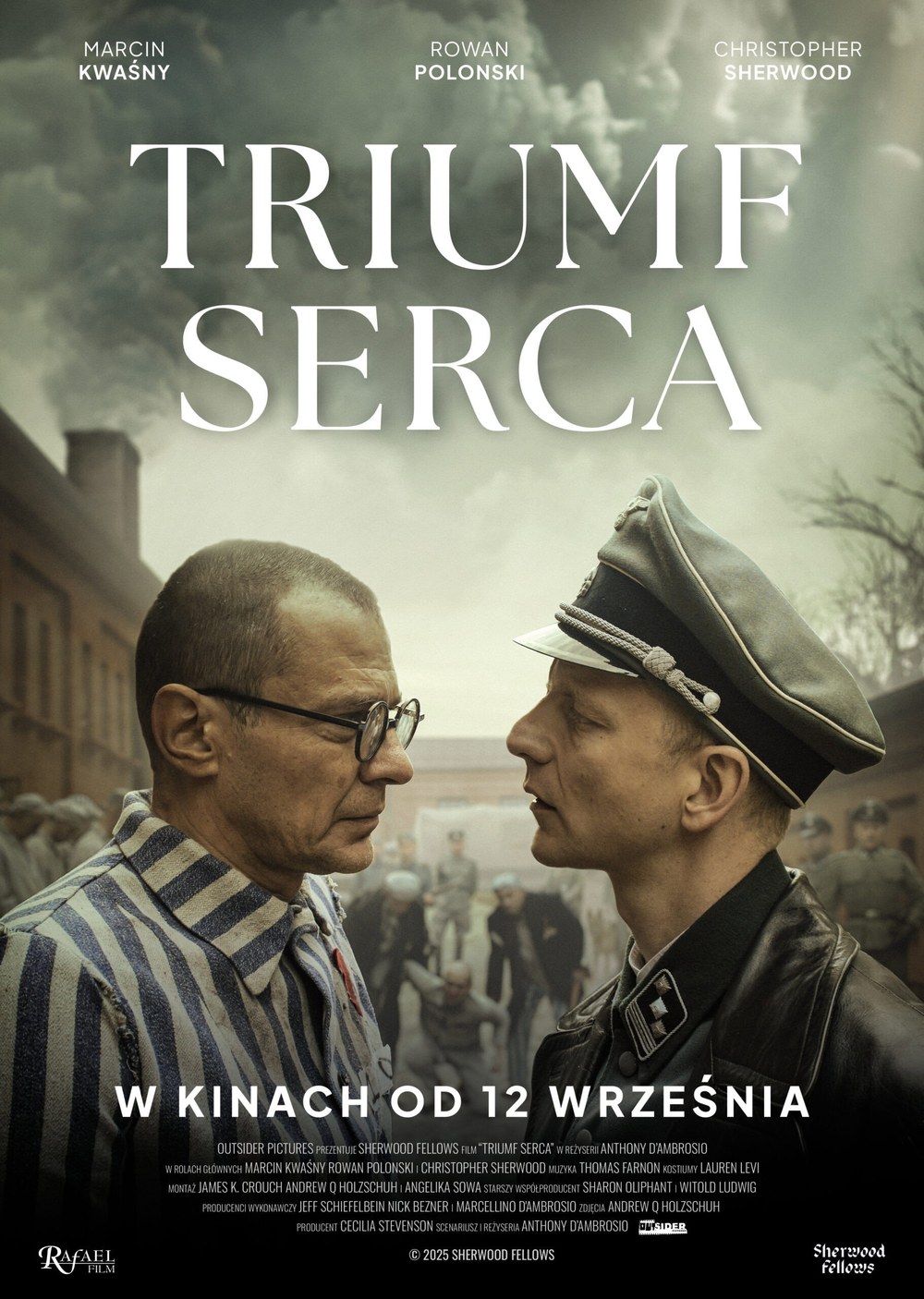
Triumph of the Heart — Foley and sound design for film
In short: Triumph of the Heart (2025), directed by Anthony D’Ambrosio, is a fact-based story of St. Maximilian Kolbe, who at Auschwitz gave his life for a fellow prisoner. On this Polish–American drama the founders of All In Sound — Olga Pasternak and Yohan Boisgontier — served as supervising sound editors (overseeing the entire sound edit), also working as Foley artist, Foley editor and sound designer. It is a genre in which the sound layer carries the physicality and the weight of every scene.
Triumph of the Heart is a 2025 biographical war drama — written and directed by Anthony D’Ambrosio. The film tells of the triumph of St. Maximilian Kolbe and his companions: the martyrdom of the friar who, at the German Auschwitz camp, voluntarily gave his life for a fellow prisoner. The leading roles are played by Rowan Polonski, Christopher Sherwood and Sharon Oliphant, with Marcin Kwaśny as Kolbe.
It is a Polish–American production (21 Five Films, CineMammoth Productions, Sherwood Fellows), made in Polish, with photography shot in Łódź. The running time is 1 h 58 m, and its Polish premiere took place on 12 September 2025. The gravity of the subject — the camp, the suffering, the sacrifice — sets sound a particular task: to be truthful, restrained and deeply moving all at once.
The role of sound and post-production
In a drama set in a camp, sound post-production does not make a spectacle — it builds the credibility of the world and the emotional weight of the scene. Three layers are crucial here.
The first is Foley — effects of the body and objects recorded live, in sync with the image: footsteps on gravel and mud, the coarse fabric of the camp stripes, the creak of wooden bunks, the clink of a metal mess tin, touch and breath. It is Foley that restores to scenes the physicality a set microphone — tuned above all to dialogue — usually fails to capture. In a period film this detail decides whether the viewer believes in the era and the place.
The second layer is sound design and the building of atmosphere — ambiences, textures and effects that give a scene its time, space and mood. The distant murmur of a roll call, wind over the yard, the silence of a starvation cell, the subtle background that raises tension below the threshold of awareness. In a story of sacrifice and dignity this layer often carries the most — because the full measure of dread is heard not in a scream, but in what happens around it.
The third layer is dialogue editing and the placing of music, and it is all bound together by the mix. The mix decides the balance of dialogue, effect and music, the dynamics, and when to give a scene over to silence. In a drama of this weight, the silence before the blow is often more important than the blow itself — and that too is a decision of the sound work.
The All In Sound approach
Our connection to this title is specific. Both founders of All In Sound — Olga Pasternak (IMDb ) and Yohan Boisgontier (IMDb ) — served on Triumph of the Heart as supervising sound editors, overseeing the entire sound edit. Both also worked as Foley artist, Foley editor and sound designer, as part of the film’s larger sound team. It is a senior credit shared by the studio’s two founders.
This craft — Foley and sound design — is at the heart of our work on film. The Foley artist re-records every step and touch by hand, in perfect sync with the image, and the sound designer assembles these elements into a coherent, breathing atmosphere. We work in a 5.1 editing/mixing room at a standardised monitoring level, with a 4 TB sound library — but true sound is only born from layering, processing and patiently recorded Foley. We write more about our experience on the about us page.
Making a feature film, a documentary or an animation in which sound is meant to really make a difference? Write to us or see our projects — we would be glad to take on the next demanding title.
Frequently asked questions
What is the film Triumph of the Heart about?
It is a 2025 biographical war drama about St. Maximilian Kolbe, who at the German Auschwitz camp voluntarily gave his life for a fellow prisoner. Anthony D’Ambrosio wrote and directed it, and Marcin Kwaśny plays Kolbe.
What is the role of Foley and sound design in a film like this?
In a drama set in a camp, sound builds the physicality and the quiet dread of everyday life: footsteps on gravel, the coarse fabric of prison stripes, breaths, distant sounds. Foley re-records these details by hand, in sync with the image, and sound design assembles them into an atmosphere the viewer can believe.
What is All In Sound's connection to this film?
All In Sound’s founders — Olga Pasternak and Yohan Boisgontier — served on this film as supervising sound editors, overseeing the entire sound edit. Both also worked as Foley artist, Foley editor and sound designer, as part of the film’s larger sound team (IMDb Olga: https://www.imdb.com/name/nm7211150/ , Yohan: https://www.imdb.com/name/nm9000059/) .